Posts

Showing posts with the label ozone

How are rocks recycled?

Image
The rock cycle The forces of nature are constantly  morphing rocks into different forms 1   Igneous rock Igneous, which means ‘born of   fire or heat’, is the rock type   formed when molten magma   cools enough to become solid.   Intrusive igneous rock forms   when the magma cools slowly   under the Earth’s surface, and   extrusive igneous rock forms   when the magma cools rapidly   on the surface, such as after a   volcanic eruption.  2   Rising heat The intense heat found below   the surface – sometimes   stemming from the planet’s   superheated core – can   generate temperatures up to   1,300 degrees Celsius, causing   the rock to melt into a molten   form called magma, which   rises towards the cooler   surface via convection. The Rock Cycle   3   Metamorphic rock The combination of intense pressure   and high temperatur...
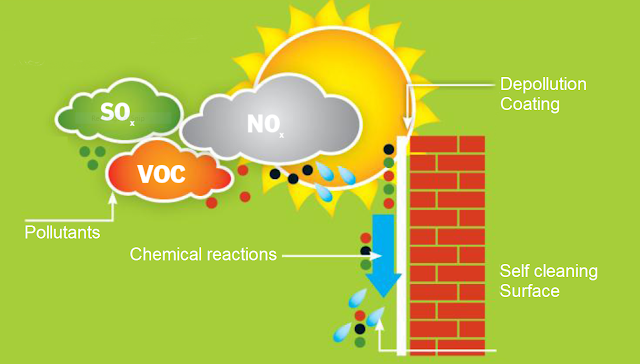
Know how this clever CristalACTiV coating can clean the air !!

Image
How CristalACTiV Works This clever coating can be painted on structures to help cleanse the surrounding air 1) Pollutants Photoreactive atmospheric pollutants like VOCs, NOx, and Sox come into contact with the depollution coating. Working of CristalACTiV coating 2) Depollution coating Under the sun’s UV light, the titanium dioxide (TiO2) coating forms highly reactive free radical particles, capable of breaking down pollutants. 3) Chemical reactions Photocatalytic reactions involving the free radicals convert pollutants to carbon dioxide, water, and harmless compounds that stick to the depollution surface. 4) Self-cleaning surface The soiled surface is washed clean whenever rain falls, or it is hosed down. Photocatalysis In some cases, airborne pollutants convert to harmless materials when they react chemically with other atmospheric gases. These reactions happen naturally in the presence of light but on a slow timescale...

Learn about the Mechanism of Exception Handling in C++

Exception Handling Mechanism in C++ To overcome the limitations of the conventional error handling mechanism, an exception handling mechanism was introduced in C++ in 1989.C++ exception handling mechanism not only guarantees the detection and handling of run-time errors but also provides a way to separate the error handling code from the rest of the program. This makes the program less complex, more readable and efficient, as the normal execution path is not interrupted for checking errors. Moreover, the error handling routine (called exception handler) is invoked automatically whenever an error occurs. Learn More:  An exception usually carries three types of information with it, namely, the type of exception , the place where the exception has occurred and the context information such as error message and other state information. C++ exception handling mechanism mainly uses three keywords, try, throw and catch. A ...

Learn What is Exception Handling in 2 Minutes

Exception Handling Writing error-free programs is the main objective of programmers. However, whenever a program is written for the first time, it usually contains errors. These errors are classified  mainly into three types, namely, compile-time errors, logical errors and run time errors. The compile-time errors and logical errors can be detected and removed by exhaustive testing and debugging. However, run-time errors are difficult to detect and trap. The run-time errors are usually referred to as exceptions. An exception is an unexpected event that occurs during the execution of a program and alters the normal flow of the program or terminates the program abnormally. The errors that can cause exceptions can range from simple programming errors, such as opening an invalid file for reading, invalid array index, etc., to serious errors such as running out of memory. Exceptions can be classified into two types, namely, synchronous exc...

Social Walls

Follow Me on

Share this Post

Recommended for You