Posts

Showing posts with the label global warming

Have you ever wondered that what causes the Wind Patterns?

Image
What causes wind patterns? Wind paths, ocean currents, and even airplanes are governed by the same invisible force W inds in our atmosphere do not travel in straight lines due to a phenomenon is known as the Coriolis effect. As the Earth spins on its axis, the motion deflects the air above it. The planet’s rotation is faster at the equator because this is where the Earth is broadest. This difference in speed creates the deflection – for example, if you were to project a ball from the equator to the North Pole it would appear to curve off-course. If Earth didn’t spin like this, air on the planet would solely circulate back and forth between the high-pressure poles and the low-pressure equator. When the rotation of the Earth is joined into the mix, it causes the air in the Northern Hemisphere to be deflected to the right, and air in the Southern Hemisphere to the left, away from the equator. As a result, winds circulate in cells. It’s this effect that causes the rotat...

How are rocks recycled?

Image
The rock cycle The forces of nature are constantly  morphing rocks into different forms 1   Igneous rock Igneous, which means ‘born of   fire or heat’, is the rock type   formed when molten magma   cools enough to become solid.   Intrusive igneous rock forms   when the magma cools slowly   under the Earth’s surface, and   extrusive igneous rock forms   when the magma cools rapidly   on the surface, such as after a   volcanic eruption.  2   Rising heat The intense heat found below   the surface – sometimes   stemming from the planet’s   superheated core – can   generate temperatures up to   1,300 degrees Celsius, causing   the rock to melt into a molten   form called magma, which   rises towards the cooler   surface via convection. The Rock Cycle   3   Metamorphic rock The combination of intense pressure   and high temperatur...

How a Single-Stream Recycling Plant can save the World?

Image
What’s Inside a Single Stream Recycling plant ? The machine that separates your recyclables so you don’t have to 1   Tipping floor A steady stream of recycling collection vehicles arrives at the facility, dumping their cargo of various recyclables out onto the tipping floor. Drivers look out for any oversized things like car engines that would cause destruction to the plant machines. 2  Loading Powerful loaders shunt heaps of mixed recyclables into a large hopper, where they are tumbled over a rotating drum to loosen compacted materials. They then flow onto a giant conveyer belt, which speeds the jumble into the main facility. 3  Manual pre-sort Teams of human sorters pick out non-recyclable items from the fast-moving stream, including crisp packets, plastic bags, shoes, and nappies, as well as big items like scrap metal that might block the machines. 4  Star screen sorting A series ...

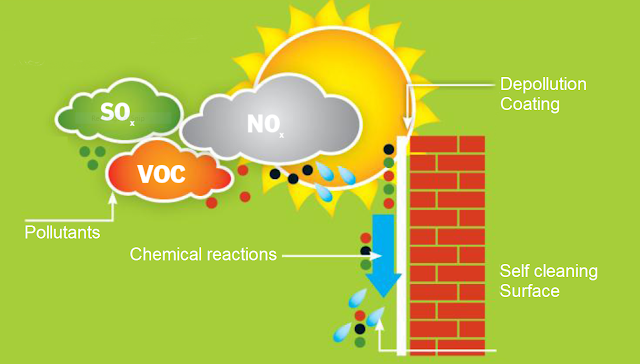
Know how this clever CristalACTiV coating can clean the air !!

Image
How CristalACTiV Works This clever coating can be painted on structures to help cleanse the surrounding air 1) Pollutants Photoreactive atmospheric pollutants like VOCs, NOx, and Sox come into contact with the depollution coating. Working of CristalACTiV coating 2) Depollution coating Under the sun’s UV light, the titanium dioxide (TiO2) coating forms highly reactive free radical particles, capable of breaking down pollutants. 3) Chemical reactions Photocatalytic reactions involving the free radicals convert pollutants to carbon dioxide, water, and harmless compounds that stick to the depollution surface. 4) Self-cleaning surface The soiled surface is washed clean whenever rain falls, or it is hosed down. Photocatalysis In some cases, airborne pollutants convert to harmless materials when they react chemically with other atmospheric gases. These reactions happen naturally in the presence of light but on a slow timescale...

Why The Gigantic Rain Clouds Appears Grey?

Image
Why are Rain Clouds Grey? The reason why overcast days are so dismal T o understand why clouds can appear grey, you first need to know why they also appear white. It’s all to do with the reflection of light. Clouds are created when air and  water vapour  near the ground warms up and rises. As it gets uplifted, the water vapour  condenses, and the droplets join together to make clouds. The more condensation there is, the more droplets there are and the bigger the clouds become. When light from the Sun passes through these large aggregations of water vapour , the droplets scatter the light in all directions. The droplets are tiny and spread out enough to scatter the entire spectrum of light, which means that they will appear white. As more water droplets accumulate and the clouds get larger, less light is able to penetrate through the cloud. What we see from the g...

Social Walls

Follow Me on

Share this Post

Recommended for You